

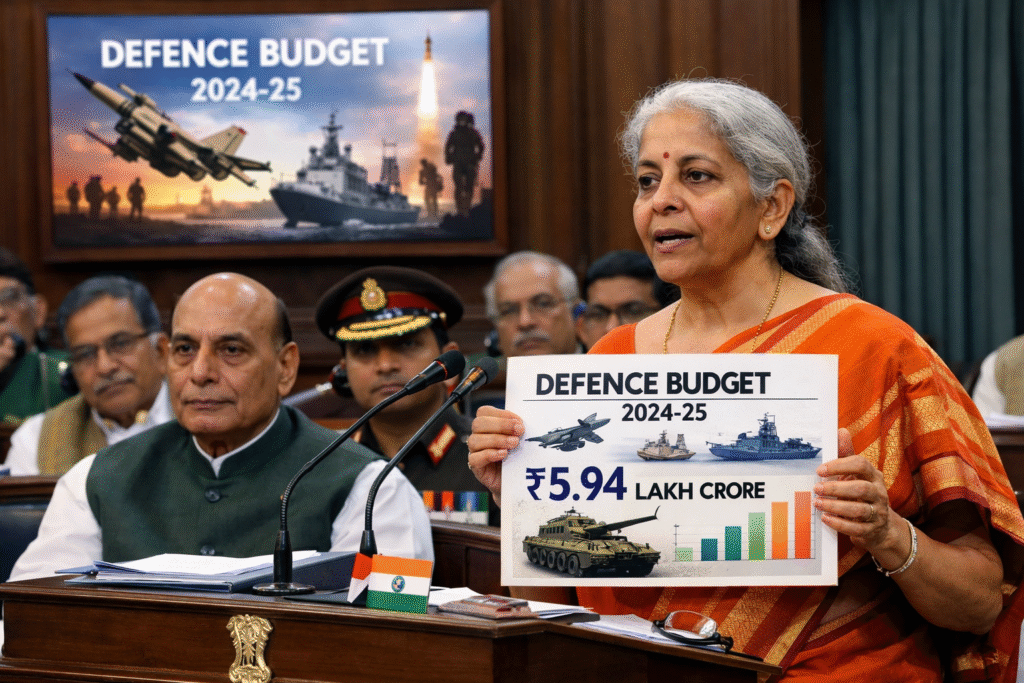
It is that time of the year once again, when the projected and planned income expenditure statement for the country is presented in the parliament, referred to as annual budget exercise eagerly looked forward to by all and sundry. Budgetary allocation for different sectors is an indication of government’s priorities. For a developing nation like ours given our security paradigm, it is a delicate balance and the debate on guns versus butter has to be tackled in a nuanced manner to ensure that the defence gets adequate boost while economic upliftment of the masses is not compromised either.
Defence budget outlay over the last few years has been steadily rising, with almost 40% increase over the last five years in nominal terms, with this year allocation touching a record ₹7.85 lakh, up 15.2% from last year’s budgeted ₹6.81 lakh crore. Last year, when the budgetary provisions for capability development and modernisation was pegged at ₹1.86 lakh crore at the RE stage, this year it has been enhanced to ₹2.19 lakh crore, a substantial increase of 21.84%. In view of OP SINDOOR last year and in the current geo-strategic uncertainty, a fillip to the defence expenditure was expected. ₹63,733 crore for aircraft and aero-engines, ₹25,023 crore has been allocated for the naval fleet, while ₹3.65 lakh crore has been allotted under the Revenue Head for operational needs, including daily running expenses like ammunition, fuel, salaries and repairs. ₹1.71 lakh crore has been set aside for defence pensions, about 21% of the total budgetary provision. As is evident, the Revenue expenditure continues at almost 62.5% of the overall financial allocation, which leaves just about 37.5% for modernisation needs. In this hi tech era, where warfare itself has been revolutionised, in the form of Cyber, Space, Drones, AI, Missiles and Rockets, India desperately needs to invest in indigenisation of its armaments as also in Research & Development, as our principal adversary to the North is miles ahead of us and has much deeper pockets.
We have made a little progress in the last couple of years, with domestic defence productions touching around ₹1.51 lakh crore in FY 24-25, an 18% increase over the previous year. We have also taken some measures to boost our defence exports, which have risen to almost ₹23000 crore, primarily radars, torpedoes, electronic warfare systems, patrol boats, helicopters and missile components. India though continues to be the second largest arms importer, after Ukraine in the world as per Stockholm International Peace Research Institute (SIPRI).We are still largely dependent for aircrafts, as Tejas is still a couple of years away from assuming the mantle of our mainstay in the skies. Similarly the missile air defence systems, the likes of S-400 are all ex-import. The latest budgetary provision of exemption in Basic Customs Duty (BCD) caters to full duty exemption on components and parts as also the raw materials imported for the manufacture of parts used for maintenance, repair and overhaul (MRO) civilian, training and other aircrafts, should provide a boost to the fledgling domestic aerospace industry.
While all the measures taken are welcome, all these amount to incremental changes, rather than any bold steps towards providing impetus to private defence industry towards their expenditure in research and development. The DRDO and PSUs receive the lion’s share of almost 77% and the private sector getting the rest. The former have a very poor track record of deliverance and hence strong checks and measures are imperative, with active involvement of defence services themselves. Private sector has benefitted as they have been banking on the defence veterans providing them the necessary technical expertise. The other major reform which has been pending is the long over due de-linking of pensionary benefits with the defence budget, as it shows an inflated figure, while the actual availability of funds stays around 1.9 -2% of GDP, as against US 3.4%, of $850 billion, of which 35-40% is for capital expenditure and Chinese1.7% (actual figures may be much higher) of $ 290 billion, of which 30-35% is capital expenditure, as against ours which is pegged at 25-27% of $82 billion ( figures are from 24-25 defence budgets). Agniveer system was resorted to primarily to address this aspect, but the Defence Civilians (who serve till 60 years of age, as against the uniformed personnel who retire at 35 on an average) continue to form almost 45% of the pensionary expenditure, who could be transferred to another suitable head, making the picture more realistic. Nevertheless, it is a budget which is on the right lines.
5 thoughts on “DEFENCE BUDGET:AN ANALYSIS”
Its a joke that the defence civilians retire at 60 and form such a large chunk of the pension benefits. This is revelation! Strange are the ways of Indian bureaucracy!!
Dear Friend
Excellent analysis of the Defence Budget. Do we have the allocation’s to Army Navy and Air Force.
Regards
Cmde Ranjit B Rai
Excellent analysis. The defence civilians will never move out of def bdgt. In fact the entire pension should be moved out of def bdgt. It should be in some other head of Consolidated fund of India.
The unfortunate Pahalgam incident had prompted India to launch OP SINDOOR. OP SINDOOR in turn has unwittingly caused a revolution in military affairs, not just within the Indian Sub-Continent, but the world over. Thus, the huge success of OP SINDOOR has tugged the purse strings of the government to build upon tactical and strategic capability in a completely new avataar. Yes, our private sector now needs a wholehearted push by the government to contribute towards national security. The government has to devise the ways and means to encourage private sector participation.
Just as you have yourself mentioned, the defence budget is pretty much a delicate and nuanced balancing act. Good job Suyash!