
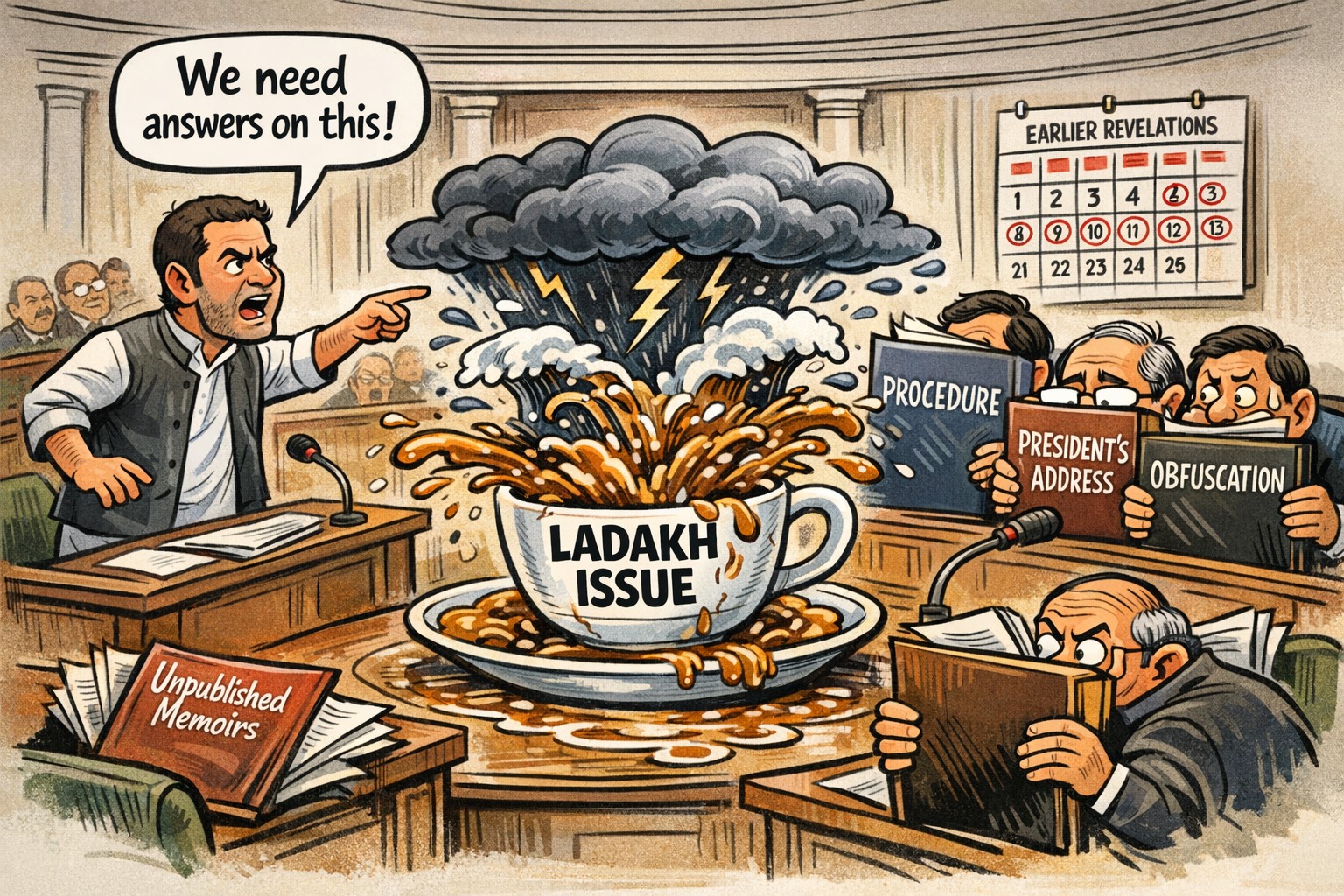
The storm in the tea cup in Ladakh raised allegedly by the unpublished book by Gen Narawane, whose excerpts appeared in a magazine some time ago, refuses to die down. This time it was Rahul Gandhi who raised the issue in the parliament, seeking clarification from the govt. As per parliamentary procedure and traditions, the President’s address is not the appropriate occasion to raise this issue, as the responses have to be restricted to the matters included in the address per se. But notwithstanding that, the issue having been raised in public on earlier occasion as well, the treasury benches should have responded in a befitting manner rather than brusquely obfuscate it blatantly. Obviously the opposition parties will draw political mileage out of any such developments. Government on its part should have assured the LOP that the issue will be responded to in the parliament after the President’s address and the responses thereto have been gone through.
While politicking may continue, the more pertinent issue is the veracity of the claims published in the Caravan magazine. If, as claimed in the article, these are excerpts from the unpublished memoirs of Gen Narawane, former COAS, then it is a matter of concern. Firstly, a COAS knows that any incident on the Line of Actual Control (LAC) with China is a sensitive one and falls in the category of classified subjects. He is also aware that he has to seek permission from the govt before publishing anything which may be detrimental to India’s security concerns. For the record, Henderson-Bhagat report on 1962 Sino-Indian conflict is still kept under wraps, so any outstanding issue, in the current scenario, ‘the stand off’, which is yet to be resolved in its entirety, will obviously not be declassified so early. If the COAS was aware, then how could he permit the publisher to release the excerpts for publication? If he did not permit it, then why hasn’t he come forward to castigate the publisher and sued him for breach of trust and contract? So was there a tacit understanding, that such a revelation would ignite a controversy which will help the sale of the book and will work as a teaser for the potential buyers? The only person who can clarify these issues is the author himself and he should come forward to clear the air once and for all.
The issue of lack of any directive from the govt for a considerable period of time, on the reported movement of the Chinese tanks in the disputed area, puzzles me. There are explicit instructions on any such violations with the formations and the commanders at the appropriate level address them as per the protocol, keeping the higher HQ in picture. When a senior commander feels that a different set of actions are to be taken, he issues orders accordingly, again keeping his hierarchy informed. The commanders looking over their shoulders for instructions at such critical junctures is a sure recipe for disaster. The Corps Commander in this case would have had near four decades of experience and was thus entrusted with such a crucial assignment of safeguarding the LAC. The predicament faced by the commander is essentially whether he should play safe, seek directions or take command decisions. In my opinion, these are the moments when the Tiger in him must awaken to give clear directions to the subordinates rather than await orders. Similarly, up the chain, commanders were passing the buck rather than tackling the bull by the horns. One understands that matters with China are not the same as they are with Pakistan, but this pusillanimity puts a question mark on their professionalism itself. We have had instances when Generals have disobeyed orders, Lt Gen Harbaksh in 1965 Indo-Pak war and Maj Gen (later Lt Gen) Sagat Singh in 1967 NathuLa. In both the cases their stand was vindicated. As the adage goes, ‘no risk no gain’, commanders ought to trust their own judgement as they are in situ and have a much better understanding of the tactical picture.
Government on its part has also not covered itself with glory, as in the first instance itself, the response should have been the same which appeared after what reportedly took almost three hours plus, “Jo Uchit Samjho Wo Karo!” giving the commander a free hand in dealing with the situation. Commanders thus must rise to the occasion and be prepared to face the consequences, that is the essence of military leadership.
10 thoughts on “Ladakh – A Storm in the Teacup !!”
Nice one. Somehow, the line ‘ Jo uchit samjho….’ , makes me as a citizen , especially having served in the Army , most uncomfortable. Whilst I dont doubt the competence and capabilities of our military leadership, but, a free hand ???
Excellent review!!Agree to every pont assessed!
Jo uchit samjho woh Karo can also be interpreted as giving a free hand. Even in the aftermath of Pahalgam massacre, or Pulwama incident a similar direction was given.
In the history, there are glaring examples of the Generals on the ground going ahead beyond the directions given by their superiors in national interests.
Unfortunately the situation has changed for worse today where no one wants to take responsibility of any action.
Although the situation as it existed then was a ‘tactical’ one, the connotations of any action would have been ‘strategic’. Hence, it is but natural that clear strategic directions were sought by the Army leadership. As regards the statement “Commanders thus must rise to the occasion and be prepared to face the consequences, that is the essence of military leadership” and examples of Lt Gen Sagat Singh, I agree with the author. However, it is easier said than done because over the last two odd decades, one has seen a gradual deterioration in the ‘risk-taking ability’ and decision making of the senior leadership. There are plenty of reasons for this but the fact is that the army leadership has become too comfortable basking in the success of sub-tactical anti-terrorist ops and in the process have lost the edge in strategic decision making. Sycophancy and image-management too have taken strong roots and are reasons for the overall dearth of leaders who can ‘look beyond the curve’ and take decisions ‘without looking over their shoulders’. Jai Hind.
When officers look over their shoulder to act and are yes man while going up the command chain, then taking decisions in hours of crisis does not come naturally. The lanyard culture is adding to this plague. Jaisa uchit samjho..I will take it as positive. If the politician holds the hand fine….Chief ke baad aur kya chaihye. Rat race ki habit…
Suyash, bingo. I’ve been wondering these last few days what exactly was wrong with the “Jo uchit samjho woh karo” orders anyway. For someone like me, that would have been music to the ears — I would have used nukes!
So why is the political leadership so defensive about it now? After 25 years in civvy street, I still go by what we learned in IMA, and this is a textbook example of that old line: “In the absence of orders, find out what they should have been and act accordingly.” That is exactly what was expected then, and it seems a few people have conveniently forgotten it!!!
As subject matter experts, Senior Military leadership was given the liberty to act befitting the need of the hour. Coming from the Govt in power reinforces the fact that they have provided the much needed back end support.
Foregoing is with my limited understanding and knowledge…
Sometimes, I wonder why our leaders—armed with experience, resources, and loyal troops—fail to act decisively in critical moments.
Well , who will decide the “ Uchit “…next time it happens. The Polity or the Military?
We must awaken before it’s too late.
With Penguin having laid their hands off the “leak” and the opposition merrily feasting away on the controversy, the book itself has become a “hot potato” ! In hindsight, when the Chinese light tanks were advancing up the gradients, a fast paced tactical situation was gradually building up. It is unfair of General Naravane to suggest that despite the political leadership having delegated him the authority, carte blanche (jo uchit samjho, wo karo), he expected a precise diktat. To me, it appears that General NNaravane had dithered, when he was supposed to have acted, given his stature as the COAS, maturity and wisdom.
Sensitive!!!
Mum is the word and Dumb is the motto!