

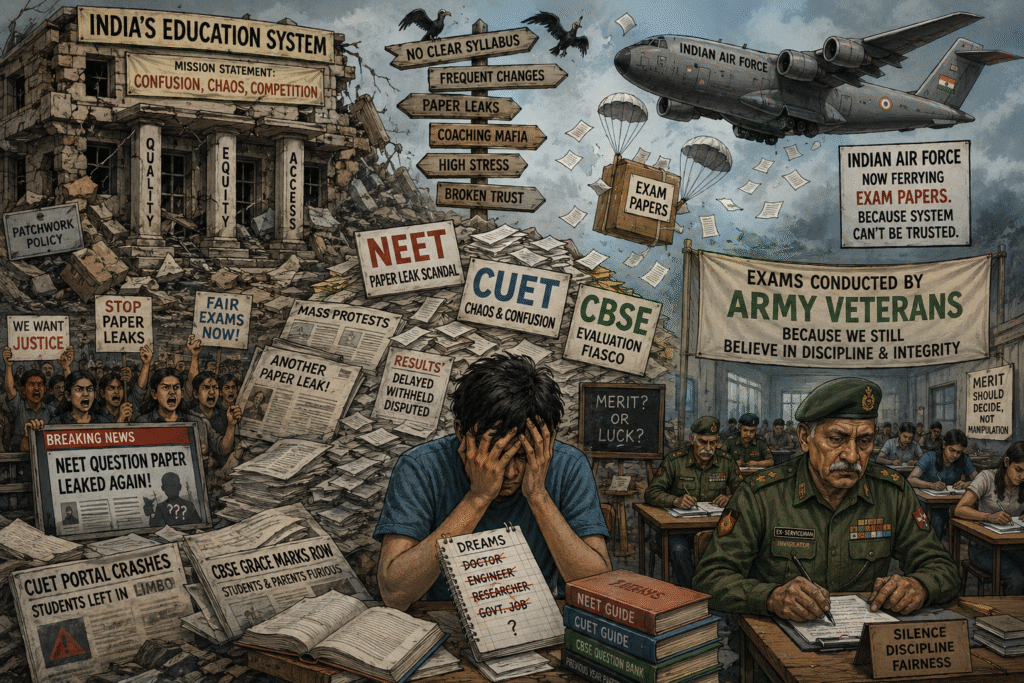
Examinations are the bane of students the world over, even if a subject is interesting, the fact that one will be examined at the end of the course/semester is the biggest dampener.But imagine if your future life, profession, everything depends on this one exam, and if the exam ends in a fiasco, which is not due to your fault, but of the agency conducting the exams, how would you feel? Well, that is exactly what has been meted out to the students in the last couple of years. Almost every exam, especially NEET, which ceased to be neat long ago,(https://thesuyashsharma.com/neet-not-so-neat-after-all/), 24 months to be precise, where it has almost become a norm to conduct a re-examination, mostly due to paper leak, or due to other considerations, such as evaluation, questions being wrong etc. The fact that by and large the students have not only maintained their calm and have taken the whole issue rather stoically speaks volumes about their patience and seriousness about pursuing their dreams. But the patience has its limits, as the govt agencies conducting these exams carry on bungling, it is about time that those responsible be brought to book themselves.
The pressures are huge, with about 24 lakh candidates registering for NEET, CUET and CBSE exams, for each. Obviously it is a herculean task, especially with unscrupulous elements out to look for procedural lapses to be exploited, to benefit the highest bidders. Unfortunately merely trying to address the conduct of exams per se is treating the systems rather than the disease. The disease here is in our education system itself, which has been rotting away over the last eight odd decades. Since schools and colleges prove grossly inadequate to impart quality education, it is left to coaching institutions to prepare the aspiring students for the competitive exams. These competitive exams are made out as ‘make or break’ for the poor hapless teens already under pressure from their parents, as cracking these exams appears to be the golden key to life’s treasures. ‘All is fair in love and war’ and this issue is a war without an iota of doubt. Naturally it implies, success at all costs, using means fair or foul.
Education ceased to be holistic long ago, today it is just a means to obtain a degree, which provides the youth with an outside chance to crack the employment jigsaw puzzle. Everyone wants a white collar job, blue collar is considered menial, deep down it stems from the caste system itself. A skilled worker earns a lot more as compared to the unemployable graduate, who will at best be a gig worker, as there are no jobs in the market.
Govt schools and colleges were pretty good until the eighties, as the oldies who passed through their portals acquitted themselves with distinction in their professional careers. My father’s generation is proof enough. But somewhere in the eighties the rot began to set in, as new schools/colleges were not being opened despite the exponential population rise. There was no fresh recruitment of teachers, contractual hiring was resorted to, with an aim to save the exchequer some funds. In the last couple of decades colleges, universities have mushroomed everywhere, with no checks and balances, these institutions produce grads, post grads by thousands, who do not have to attend any classes. The exams conducted are a sham, consequently, the freshly minted graduate armed with a degree has no knowledge of any of the subjects. A commerce grad who doesn’t know what a balance sheet is, or an IT engineer who can’t write a simple three lines code, as they have cleared the exams through leaked papers or through other means in the compromised system. This graduate is a very dangerous person, as he/she is unsuitable for any job as he has no knowledge but armed with his degree, he considers himself wronged and is naturally frustrated.
Is a course correction possible? Well, yes of course, treat education as a key area, as our civilisation depends on this crucial factor. The root cause is corruption, the agencies are corrupt, naturally every rule is given a go by. Bureaucracy, when found wanting like in the recent fiasco is punished by mere transfers, which I am afraid is no punishment. It may actually be a reward, since they may land up in a more lucrative department where there are better opportunities, with even less accountability. So revert to govt run institutions, recruit permanent teachers, pay them better and do away with all these coaching institutions, incorporate them in the teaching curriculum itself. Conduct the exams, year round, with minimum three chances for improvement of scores. Create a special organisation for conduct of all professional exams, which should be headed by technocrats like Nilekeni and educationists with no interference by the bureaucracy. As the Air Force is being utilised for ferrying the papers, I dare say, employ the veterans from the armed forces for conduct of exams also. They won’t let you down.
16 thoughts on “WE DON’T NEED NO EDUCATION”
Education and wisdom are two parallel tracks. In our country as you have righly said getting a degree by any means is the order of the day. Somewhere the sheen of the golden age is dimmed by this yearly rituals.
There is an urgent need for drastic change in present education system. These Coaching centres are profit making business centres and teachers are not doing justice with the students.
Well done Suyash. You must use your writing skills and intelligence to highlight social issues. Good
Edn system is torn apart in India. Between medicine n edn it’s anyone’s toss which is more broken n corrupt.
In 2026, we fall back on Defence forces to carry test papers etc just as we did for floods, gutter hole rescues.
And we aim to be the third largest economy.
I guess I must keep my hopes alive
Nicely penned.
👍
An urgent change is needed. But when and how is a question.
Very well written Suyash
All facets of the Contemporary issues ailing the Current Education System in the Country, with viable recommendations for improving the System have been very well brought out.
A Very Comprehensive and well written Article.
India’s education crisis is not just about leaked exam papers. It is the result of creating a single ladder of success….doctor, engineer, bureaucrat. *Gandhi’s Nai Talim* sought dignity for skilled work and multiple pathways to livelihood. We need world-class STEM education, but also equal respect for technicians, artisans and entrepreneurs….
What India Can Learn from the Canadian Education System
The Problem with Central Exams
We have central board exams because teachers are not deemed trustworthy. But student assessment should be a continuous process throughout the academic year or semester. A study of the Canadian education system—at both high school and university levels, through which our children passed—reveals several striking differences.
Course Content
I was flabbergasted to see our daughter taking Bollywood Music and Premchand Ki Kahaniya as optional subjects in the second and third year of a life science B.Sc. course. I am certain no Indian university would offer such subjects. In Canada, students have a wide variety of courses to choose from, and different universities have different prerequisites for postgraduate admission.
Assignments
Assignments typically constitute 15 to 20 percent of the total grade. One cannot get away by copying from friends. Plagiarism is treated very seriously and may even result in failing the course. Original work and original ideas are well rewarded. Assignments are given every week or at least once every fifteen days, and are mostly corrected by Teaching Assistants (TAs)—research students working under the professor, who earn a stipend for their assistance.
Tests
There are anywhere from two to four tests in a semester. Midterm tests range from 25 to 40 percent each, and the total weightage for tests is about 50 to 80 percent, depending on the professor. The key point: you do not lose all your points if you miss the final. If you fall sick or struggle with certain chapters, you are not penalised for that single event. The risk is evenly distributed. The catch? You are forced to study throughout the semester because you have tests every four to six weeks. Some tests are comprehensive, but most cover only part of the text. The professor who teaches the class dictates the rules of testing—and in that domain, the professor is God.
Quizzes
Quizzes are quite important. Some are online, others are pop quizzes or surprise quizzes in class. Their weightage can range from 5 to 20 percent. You must be prepared every time, with full command of previous class material.
Projects (Group and Individual)
Projects can account for 20 to 40 percent of the grade. The goal is to ensure students apply what they have learned. Group projects typically involve two to five people; individual projects are solo efforts. In either case, students deliver a final presentation in class. Presentation skills are developed from high school onward, and students are well trained in executing both group and individual projects.
Term Papers
Some classes have no exams at all—only research papers. These papers must follow a prescribed format with full citations, adhering to APA or other university-mandated styles (a discipline that begins in high school). For arts and literature classes, midterms are rare; instead, students typically write two or three papers over the semester.
Class Participation
About 5 to 15 percent of marks are allocated to class participation. Students must actively join discussions, which means they must be fully prepared for every class. TAs seated at the back do the marking, and the professor awards the final grade.
Co-op Programs
Co-op programs bring industry and academia together, allowing students to work in their field while still in university. In some institutions, co-op assignments are mandatory. This ensures that education remains aligned with industry developments. The curriculum aims to expose students to real industrial and business processes, and student projects are often tied to actual problems identified by industry partners.
Recommendations
For any job application—even part-time—or for postgraduate admission, it is mandatory to provide recommendations from two or three professors. If you are not well known to a professor, they will simply state that they are not comfortable giving a recommendation. Recommendations cannot be bought easily.
The Link Between Education and Economic Progress
The economic progress of a country is strongly linked to the quality of its education. The Canadian education system, from school level upward, undertakes periodic curriculum reviews to ensure that content remains up to date and not obsolete. It also ensures that the system effectively fulfills the country’s need to produce valuable citizens for the future. Norms and standards are designed to equip students with skills suited to a rapidly changing economic landscape.
Final Reflection
We will always get the education system we deserve—not the one we desire. The question is whether we are willing to deserve a better one. The Canadian model is not perfect, but its emphasis on continuous assessment, original work, real-world application, and student accountability offers lessons worth considering. Until we trust our teachers, reward creativity, and penalise plagiarism seriously, central exams will remain a poor substitute for genuine learning.
Excellent writing as always.
The rot is deep rooted. Unfortunate to have fools who are least bothered about such repeated lapses and continue with impunity. Accountability has to be there coupled with deterrent punishment.
Sorry state of affairs.
While it is a dependable option for Armed forces conduct crucial entrance exams in the country, it is tragic to see that things are going from bad to worse in the education sector in India. At every touchpoint in the journey of a student, it is a letdown for the best minds in the world. Lack of integrity of exams, fake reservation certificates, subpar professors in top Govt. Colleges, lack of practical application in technical degrees, no semblance with industries, govt and corporate sector for absorption of students as recruits, situation of degree education in the country is in shambles.
The colleges don’t know what the job market wants, the job market says the students don’t have what it takes. No semblance whatsoever.
Thank you for writing a comprehensive piece about the much needed topic and giving apt solutions.
Great write up Sir, your thoughts are very well outlined and solutions are totally relatable with the expectations of the comman man.
True random sequence generation code is required to make every exam paper in any hall unique. each repeat paper must have different value generated by auto code. today it’s possible. all exams be online from exam centres. all checking be auto code with zero human hands.
Suyash, very well brought out. This isn’t an isolated issue. Corruption runs through every level — it started with politicians and government officials, and once people saw it was the fastest way to wealth, the rot spread everywhere. The corrupt aren’t punished; they are rewarded with votes, promotions, and impunity. And it’s not just the government sector anymore — private institutions are just as infected. Makes you wonder how many more skeletons are being quietly built, waiting to tumble out. The only real fix is extremely stringent action against the corrupt… but let’s be honest, that doesn’t look likely anytime soon. At the same time, your suggestion to improve the system is very positive and promising; Hope someone takes it forward.; Arun
Quoting from the Bible, Mahatma Gandhi would say, “if the salt have lost his savour, wherewith shall it be salted?” or words to that effect. Moral Integrity has no replacement. Best we recognise that!